

ABOUT THE CLT MODEL
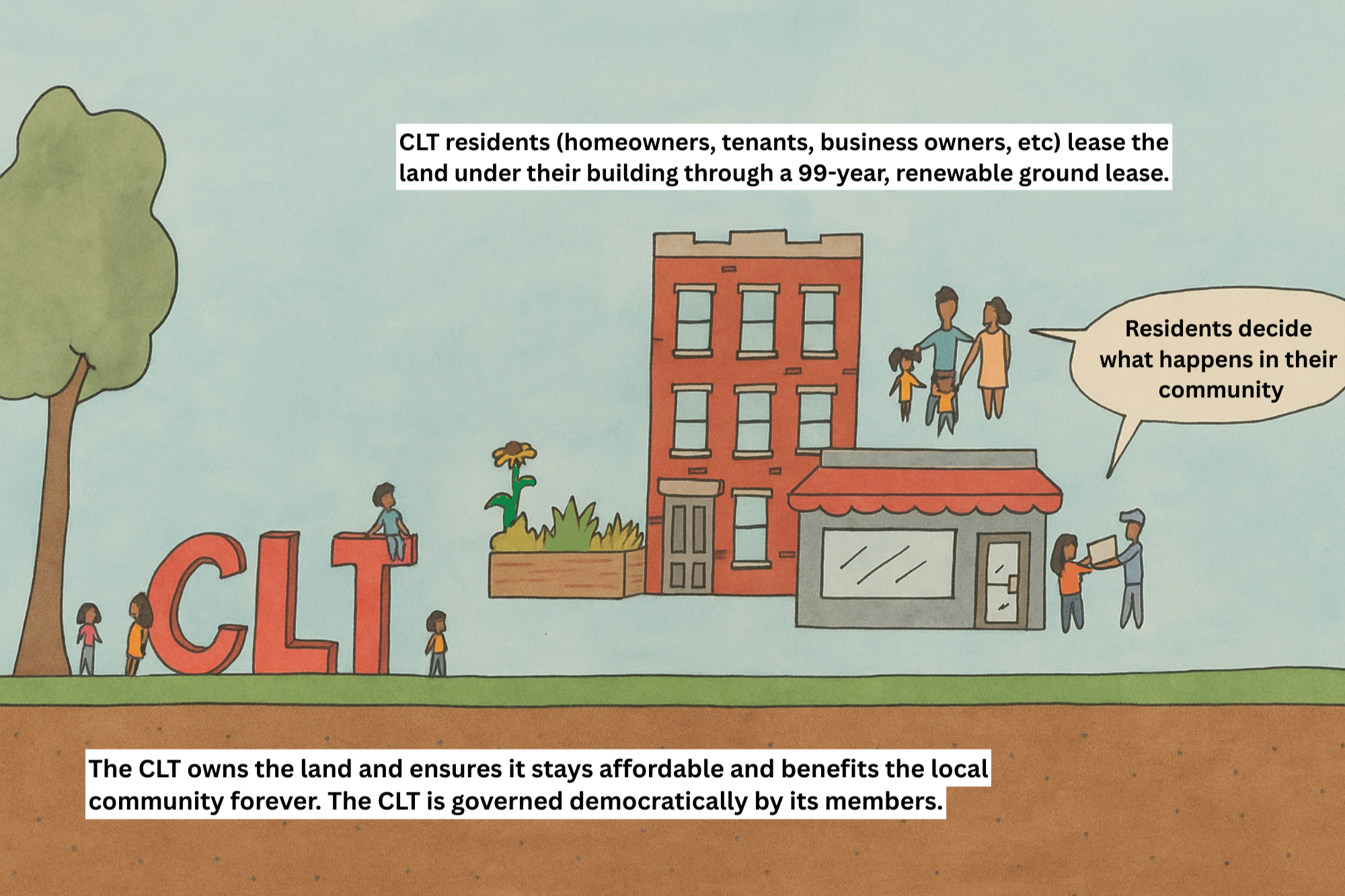
A Community Land Trust (CLT) is a nonprofit organization run by a board of local residents. Its purpose is to acquire and steward land in a way that protects long-term community benefit. The CLT owns the land itself, while the buildings on that land—such as homes, small businesses, community gardens, and community centers—are individually owned or rented.
People who live or operate businesses on CLT land (including homeowners, tenants, and business owners) lease the land underneath their buildings through a 99-year renewable ground lease. This lease spells out affordability requirements and other important terms that apply to all CLT properties. Because the lease is both long-term and renewable, it ensures that affordability and community control are protected permanently. This permanence keeps multiple generations rooted in their homes and neighborhoods, and it guarantees that public or private investments in CLTs are not lost over time due to expiring affordability restrictions.
-
There are over 200 CLTs across the United States in urban, suburban and rural areas. For us, the most effective CLTs are those that center racial and economic justice, do grassroots organizing, and make housing available to very low-income households. A few examples of successful CLTs are Cooper Square in NYC, Dudley Street Neighborhood Initiative in Boston, San Francisco CLT, TRUST South LA, and Champlain Housing Trust in Burlington, Vermont.
-
CLTs can acquire land in a variety of ways:
Land gifted by government entities
Land gifted by private property owners
Tax-delinquent or vacant properties, including partnerships with land banks
Bank foreclosures
Conventional property purchases, which can also include first-right-of-first-refusal agreements
-
Facing eviction from their homes and farms by white farmers in the 1960s for exercising their right to vote, Black sharecroppers and civil rights activists in the Student Non-violent Coordinating Committee (SNCC) saw collective land ownership as a key piece of securing liberation. In 1969, they collectively purchased 5,000 acres for housing and farming, establishing New Communities Inc., the first contemporary CLT in the United States. Charles Sherrod, President of New Communities, Inc. CLT and SNCC member, famously said: “The only way African Americans in the Deep South would ever have the independence and security to stand up for their rights — and not be punished for doing so — was to own the land themselves.”
Since then, rural and urban communities have continued to use CLTs to advance collective self-determination as part of broader racial and economic justice efforts. CLTs achieve this in many ways: by providing space and resources for housing, food, small businesses, arts, and culture; and by serving as an organizational framework that enables communities to participate directly in the planning and decision-making around these spaces.
-
The split ownership structure in the CLT model 1) takes land out of the speculative market to stabilize neighborhoods, and 2) removes the cost of land for individual residents, which keeps their housing affordable.
The East New York CLT is committed to deep and permanent affordability and seeks to serve low-income households poorly served by the private market.
-
CLTs have proven especially effective at stabilizing and empowering communities during and after periods of acute crisis. For example, a study by the Lincoln Institute of Land Policy found that CLTs helped protect residents during the 2008–2009 foreclosure crisis.
Two major findings from these studies stand out:
Homes in community land trusts experience lower rates of delinquency and foreclosure compared to homes with conventional mortgages.
The widespread use of comprehensive stewardship practices—including education, prevention, and intervention—likely contributes to these lower delinquency and foreclosure rates, as well as higher rates of successful loan cures in CLTs.